Mimir
Grand Prize at CMU Claude Builder Hackathon · $1,500 · ML lead, UX
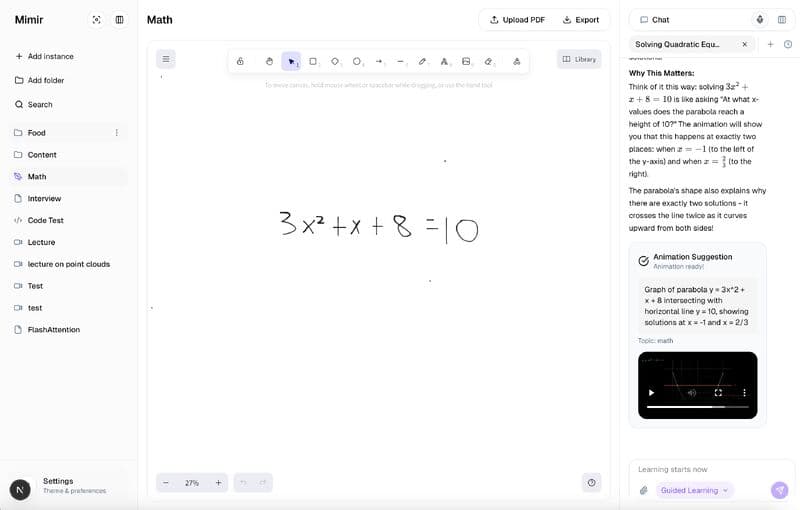
Mimiris a tutoring workspace that teaches from a student's own notes, code, and lectures instead of handing them the final answer. The tutor sees that material and is told to guide the next step rather than solve the problem. It can animate an explanation, quiz what the student just studied, and turn one recorded lecture into study material in six forms. It won the $1,500 grand prize at the CMU Claude Builder Hackathon.
The Problem
Students paste homework into a chat model, copy the final answer, and move on. The model never sees the code, notes, or lecture they were actually working from, and it is rewarded for finishing the problem rather than for making the steps understandable.
Tech Stack
What Mimir Does
Mimir turns AI into a personalized tutor, not an answer generator, by embedding it directly into a learning workspace.
- Tutor Mode (Live Guidance): An AI tutor with access to the full workspace context guides students through problems step by step — like a real teacher sitting beside them.
- All-in-One Learning Workspace: Students can code in a built-in IDE, read textbooks, write notes, solve math problems, and watch lecture videos in one place.
- Generative Visual Explanations: A custom visual engine scripts and animates mathematical explanations using Manim, breaking complex topics into digestible, step-by-step visuals.
- Active Learning Tools: Automatically generate flashcards, quizzes, and practice problems grounded in the material the student is working on.
- Voice-Enabled Tutoring: Conversational, voice-based sessions allow students to ask questions naturally and reason aloud as they work.
How It Works
Mimir is built around the idea that learning requires context, feedback, and struggle — not just answers.
Full-Context Tutoring
Unlike chat-based AI tools:
- The tutor has access to the entire workspace
- It sees the student's code, notes, math work, and reference material
- Guidance is contextual and incremental, not solution-dumping
The tutor is explicitly instructed to guide, not solve.
Generative Visualization Engine
Many concepts fail because they're hard to visualize.
- Mimir uses Manim to programmatically generate animated explanations
- Visuals are tailored to the specific concept the student is struggling with
- Complex ideas are deconstructed into sequential steps rather than static diagrams
This bridges the gap between symbolic math and intuitive understanding.
Multimodal Learning Loop
- Text, code, visuals, and voice are tightly integrated
- Students can switch modalities without losing context
- Voice tutoring enables natural back-and-forth reasoning, mirroring real instruction
System Design
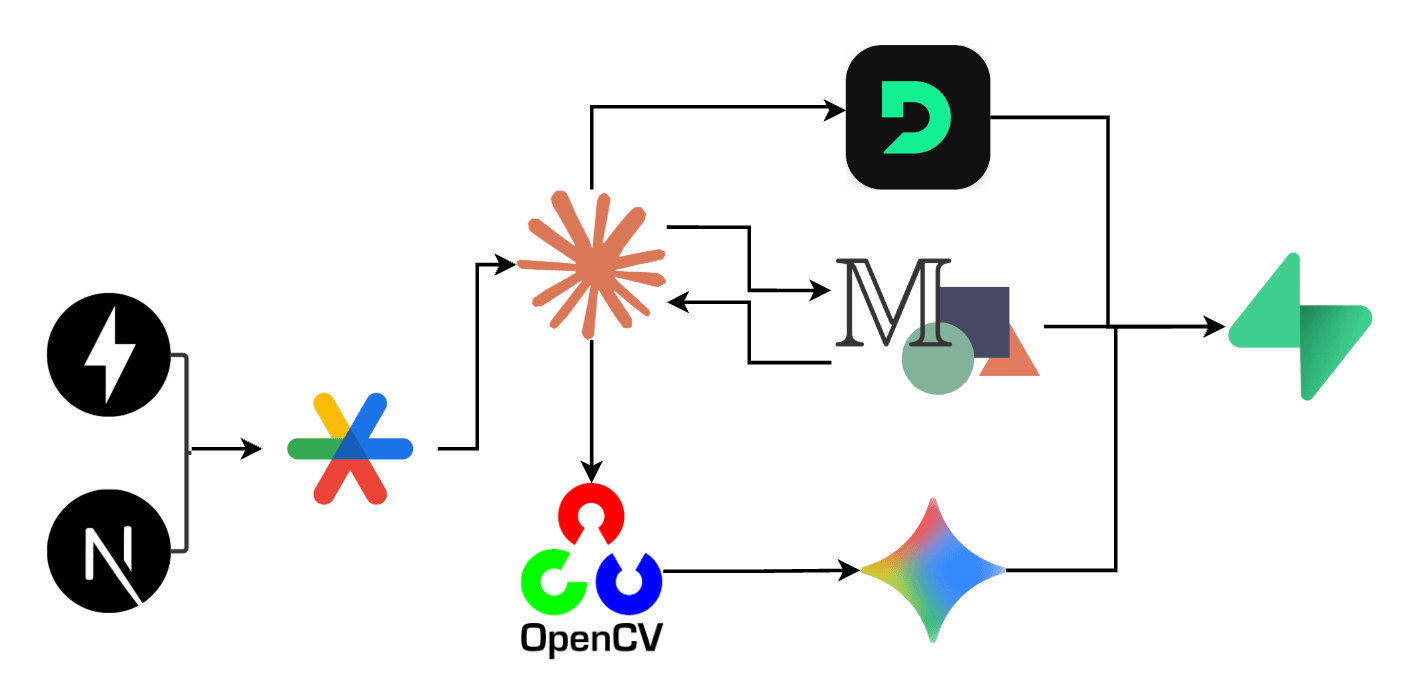
- LLM reasoning powered by Claude
- Workspace-aware prompting ensures responses stay grounded
- Modular architecture allows new learning tools (e.g. quizzes, visualizations) to plug into the same context engine
Challenges & Solutions
- Preventing Answer Dumping: We explicitly designed the tutor to refuse direct solutions and instead scaffold understanding.
- Maintaining Context: Keeping the AI grounded in a rich, evolving workspace required careful context construction and prompt design.
- Visualization Complexity: Generating accurate, pedagogically useful animations demanded tight coupling between math reasoning and visual scripting.
- Cognitive Load: We focused on pacing explanations to support learning without overwhelming the student.
Outcome
The lecture pipeline turns a recorded lecture into study material across 6 learning modes, next to the workspace tutor and the Manim visualizations.
What's Next
- Adaptive Learning Paths: Automatically adjust tutoring strategies based on student progress and misconceptions.
- Expanded Visual Library: Richer, reusable visual explanations across math, CS, and physics.
- Collaborative Tutoring: Shared workspaces for study groups and peer learning.
- Institutional Integrations: LMS and course-level deployment for classrooms and universities.